Equitable Interest in Property
Resulting Trust and Equitable Interests
Thomas H. Curran Associates’s bankruptcy and commercial litigation lawyers have decades of experience prosecuting and defending equitable claims and remedies on behalf of trustees, creditors and debtors in bankruptcy, federal and state courts. Equitable claims are extremely fact intensive and generally depend on the court’s evaluation of a series of factual tests to establish liability. Bankruptcy trustees and creditors typically assert claims against third parties, often a debtor’s insiders, to establish an equitable interest in property that can be reclaimed for the bankruptcy estate or creditors.
Courts impose equitable remedies such as resulting trusts and constructive trusts in real estate and personal property, LLC membership interests and corporate shares. Constructive trusts follow claims against third parties for unjust enrichment or fraudulent transfer based upon the inequities of the a particular transaction or ownership structure. Factors a court often considers are: the intent of the transferor and nominal owner of the property, the contribution of the debtor towards the acquired property, the debtor’s involvement with the maintenance and upkeep of the property, the debtor’s control over the business or property interest, the intent of the transaction giving rise to the property acquisition and many other case specific factors. Resulting trusts and other equitable proceedings usually result in a court declaration that the trustee or the debtor is the true owner of property held in another’s name, which can then be reached by the debtor’s creditors. Related equitable remedies such as attachment and injunctive relief often accompanies a trustee’s request for the imposition of a resulting or constructive trust judgment.
Thomas H. Curran Associates’s attorneys are intimately familiar with the factual and legal complexities of prosecuting and defending claims for resulting trust, constructive trust and related equitable remedies. They have tried cases in bankruptcy, federal and state trial and appellate courts and can assist clients in bringing and defending such claims and remedies.
Litigation Practice Results
Recent successful cases handled by the attorneys at Thomas H. Curran Associates. Find more here »
Foreclosure of residential and commercial real property varies by state because each one has its own laws governing the process and addressing such issues as the property owner’s options for bringing the loan current and the process for selling the property. Generally, foreclosures fall into two categories: (i) by judicial process or (ii) by statutory power of sale contained in the mortgage. Thomas H. Curran Associates mortgage foreclosure lawyers have conducted foreclosures under both methods in various states. The Firm has also served as foreclosure defense attorneys in certain cases. In many cases, Thomas H. Curran Associates’s lawyers also represent lenders and servicers in bankruptcy courts in cases that arise in connection with foreclosure proceedings. Individuals and businesses facing foreclosure should seek experienced legal counsel as early as possible to understand their rights, evaluate available options, and determine whether negotiation, litigation, or other legal remedies may help protect their interests.
In states that require judicial foreclosure, mortgagees must commence a foreclosure lawsuit asking the court for the right to sell the property in satisfaction of the underlying debt. Throughout the litigation, both lenders and borrowers may face complex procedural and evidentiary issues that require experienced legal representation. Judicial foreclosure is the primary method of foreclosure used in 22 states, including Florida, Illinois, New Jersey, New York, and Pennsylvania. When the state allows for it, the lender’s attorneys may ask the court to grant it a deficiency judgment if selling the property is not expected to fully pay off the borrower’s debt. If granted, the borrower will remain responsible for any unpaid debt following the foreclosure sale. Alternatively, there are 28 states that allow for non-judicial foreclosures, including Massachusetts, California, Texas, and Georgia. In those states, the mortgage foreclosure process is typically faster because it does not originate through the courts unless the borrower chooses to sue the lender.
The last significant U.S. economic downtown that began in or around 2008 stemmed in large part from the excesses of the home mortgage sector of our economy and related substandard lending practices. The resulting nationwide wave of foreclosures spawned years of litigation challenging mortgagees and lenders and servicers’ right to foreclose mortgages. This foreclosure litigation resulted in many novel legal theories to prevent foreclosure. Thomas H. Curran Associates’s lawyers have years of experience successfully litigating an array of mortgage foreclosure cases that raised numerous complex and novel defenses across multiple jurisdictions in both state courts and bankruptcy courts, with some cases resulting in complex appellate proceedings. The Firm also has deep expertise in ancillary relief such as receiverships and injunction proceedings that are sometimes required to secure the property during the foreclosure process.
By virtue of their broad and deep foreclosure and bankruptcy expertise, the attorneys at Thomas H. Curran Associates are uniquely positioned to advise and represent mortgage lenders and servicers, as well as borrowers in some cases, with their foreclosure proceedings. Our lawyers seek to utilize their experience advocating on behalf of clients to provide them with quality representation while assisting them in prosecuting or defending their foreclosure proceedings in the fastest, most efficient manner.
Thomas H. Curran Associates Secures Appellate Victory in Insurance Coverage Dispute
In a significant legal victory, Thomas H. Curran Associates (THCA), representing the Plaintiff-Appellant, successfully overturned a trial...
Supreme Court Denies Final Appeal, Finalizing Judgement Obtained by THCA
On June 24, 2024, the Supreme Court of the United States declined the petition to review filed by Sean Dunne and his ex-wife Gayle...
Thomas H. Curran Associates Secures Appellate Victory as Massachusetts Supreme Judicial Court Denies Appellant’s Attempt to Shortcut Ordinary Appellate Review
Thomas H. Curran Associates recently obtained an appellate victory in the Massachusetts Supreme Judicial Court on May 26, 2023, in the...
Thomas H. Curran Associates win is Affirmed in Florida, U.S. District Court – Client Wins Attorneys Fees
Law: Federal Rule of Civil Procedure 37(a)(5) Case: Premier Capital, LLC v. Larry Bryan (AP) Underlying Bankruptcy Case: In re Larry Bryan...
The Second Circuit Affirms Bankruptcy Fraud Judgment Obtained by Thomas H. Curran Associates, Recognizing the Continuous Concealment Doctrine
Law: Continuous concealment doctrine, 11 USC § 727(a)(2)(A), In re Olivier, 819 F.2d 550 (5th Cir. 1987); In re Boyer, 328 F. App’x 711,...
Thomas H. Curran Associates prevails on barring discharge due to fraud by debtor
Thomas H. Curran Associates recently secured a victory on behalf of an institutional asset manager, where the Bankruptcy Court for the...
Thomas H. Curran Associates Secures Appellate Victory in Insurance Coverage Dispute
In a significant legal victory, Thomas H. Curran Associates (THCA), representing the Plaintiff-Appellant, successfully overturned a trial...
Supreme Court Denies Final Appeal, Finalizing Judgement Obtained by THCA
On June 24, 2024, the Supreme Court of the United States declined the petition to review filed by Sean Dunne and his ex-wife Gayle...
Thomas H. Curran Associates Secures Appellate Victory as Massachusetts Supreme Judicial Court Denies Appellant’s Attempt to Shortcut Ordinary Appellate Review
Thomas H. Curran Associates recently obtained an appellate victory in the Massachusetts Supreme Judicial Court on May 26, 2023, in the...
Thomas H. Curran Associates win is Affirmed in Florida, U.S. District Court – Client Wins Attorneys Fees
Law: Federal Rule of Civil Procedure 37(a)(5) Case: Premier Capital, LLC v. Larry Bryan (AP) Underlying Bankruptcy Case: In re Larry Bryan...
Thomas H. Curran Associates Secures Appellate Victory in Insurance Coverage Dispute
In a significant legal victory, Thomas H. Curran Associates (THCA), representing the Plaintiff-Appellant, successfully overturned a trial...
Supreme Court Denies Final Appeal, Finalizing Judgement Obtained by THCA
On June 24, 2024, the Supreme Court of the United States declined the petition to review filed by Sean Dunne and his ex-wife Gayle...
Thomas H. Curran Associates Secures Appellate Victory as Massachusetts Supreme Judicial Court Denies Appellant’s Attempt to Shortcut Ordinary Appellate Review
Thomas H. Curran Associates recently obtained an appellate victory in the Massachusetts Supreme Judicial Court on May 26, 2023, in the...
Litigation Areas of Expertise
Litigation News

The State of Healthcare Bankruptcy in the U.S.: Why 2025 Is a Turning Point
Jennifer Riggins sits down with Thomas Curran, Managing Partner of Thomas H. Curran Associates, to unpack the accelerating wave of...
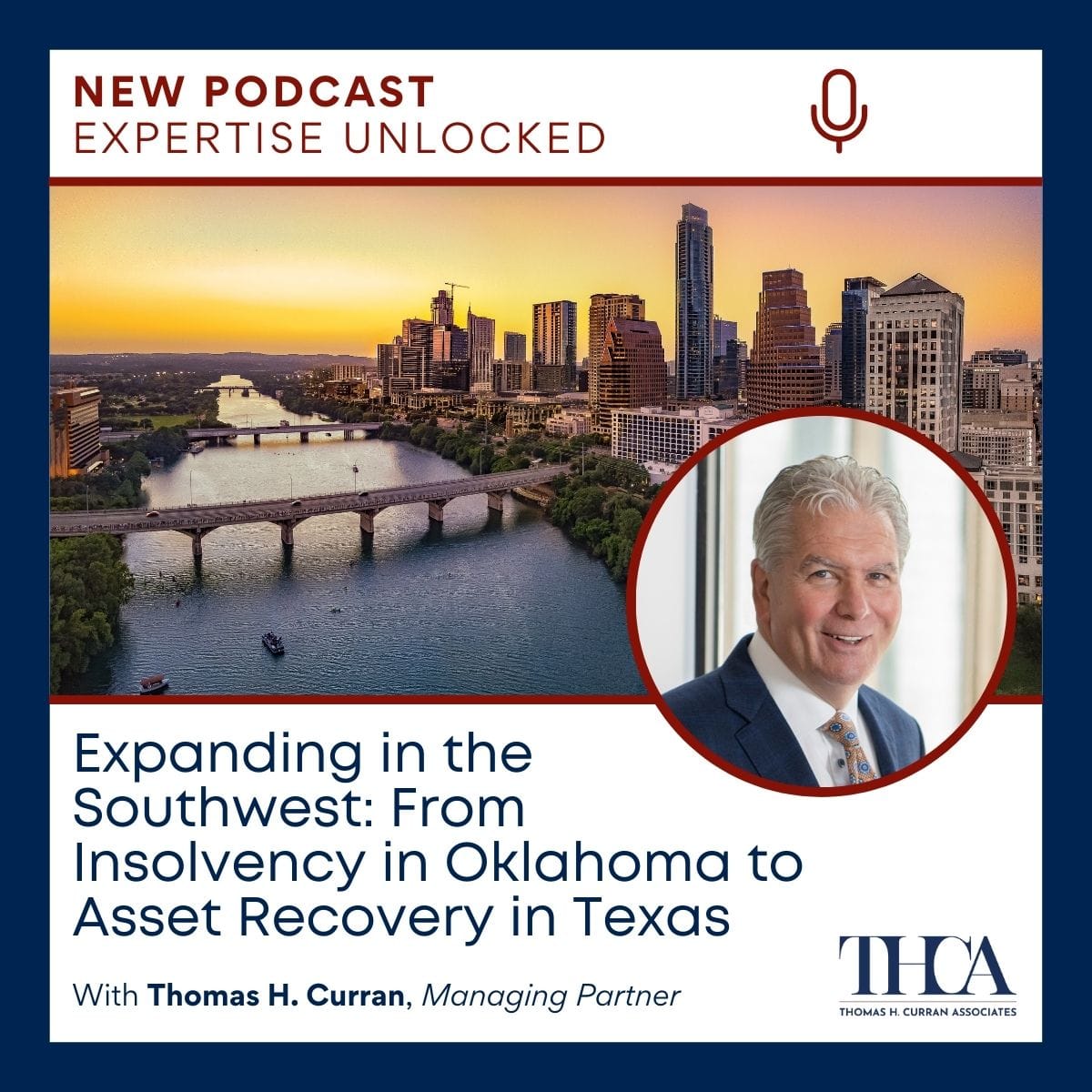
Expanding in the Southwest: From Insolvency in Oklahoma to Asset Recovery in Texas
In this episode, Jennifer sits down with Thomas Curran, founder of Thomas H. Curran Associates, to explore the rapidly evolving world of...

Disciplinary judge approves lawyer’s suspension for using ChatGPT to generate fake cases | Colorado Politics
Recently, a Colorado lawyer received disciplinary action for employing artificial intelligence to generate fake case citations in a legal...
US appeals court proposes AI restrictions in all court filings | Jurist
In November, the US Court of Appeals for the Fifth Circuit proposed a new rule requiring lawyers to certify that they either did not use...

Mallinckrodt’s Second Bankruptcy Would cut $1 Billion from Opioid Settlement | STL Today
The Irish based company, Mallinckrodt’s, second bankruptcy may place creditors in ownership of the company and cut $1 billion from the...
The FTC’s case against Microsoft’s Activision acquisition is not going well | Vox
Microsoft and Activision Blizzard are overcoming hurdles to their $69 billion dollar merger. If the merger goes through, Microsoft will...
The State of Healthcare Bankruptcy in the U.S.: Why 2025 Is a Turning Point
Jennifer Riggins sits down with Thomas Curran, Managing Partner of Thomas H. Curran Associates, to unpack the accelerating wave of...
Expanding in the Southwest: From Insolvency in Oklahoma to Asset Recovery in Texas
In this episode, Jennifer sits down with Thomas Curran, founder of Thomas H. Curran Associates, to explore the rapidly evolving world of...
Disciplinary judge approves lawyer’s suspension for using ChatGPT to generate fake cases | Colorado Politics
Recently, a Colorado lawyer received disciplinary action for employing artificial intelligence to generate fake case citations in a legal...
US appeals court proposes AI restrictions in all court filings | Jurist
In November, the US Court of Appeals for the Fifth Circuit proposed a new rule requiring lawyers to certify that they either did not use...
The State of Healthcare Bankruptcy in the U.S.: Why 2025 Is a Turning Point
Jennifer Riggins sits down with Thomas Curran, Managing Partner of Thomas H. Curran Associates, to unpack the accelerating wave of...
Expanding in the Southwest: From Insolvency in Oklahoma to Asset Recovery in Texas
In this episode, Jennifer sits down with Thomas Curran, founder of Thomas H. Curran Associates, to explore the rapidly evolving world of...
Disciplinary judge approves lawyer’s suspension for using ChatGPT to generate fake cases | Colorado Politics
Recently, a Colorado lawyer received disciplinary action for employing artificial intelligence to generate fake case citations in a legal...
Contact Us
Are You In Need of Legal Counsel for Commercial Litigation, Business Transaction Matters, or a Bankruptcy Matter?
Contact our team today.
Call us at (617) 207-8670 or click the button below.
Austin Office
7710 N. FM 620
Building 13-D
Austin, TX 78726
Boston Office
15 Broad Street
Suite 610
Boston, MA 02109
New York Office
305 Broadway, Suite 700
New York, NY 10007
London Office
The Leadenhall Building
Level 30
122 Leadenhall Street
London EC3V 4AB
Tags: equitable interest in property resulting trust land law equitable interest in real estate